
Essential Tools for Baking in Nigeria
Success in baking for beginners Nigeria begins with the acquisition of appropriate instrumentation. Unlike cooking, which allows for improvisation, baking is a precise chemical reaction dependent on accurate ratios. The primary challenge faced by Nigerian bakers is often the lack of standardized equipment.
The Oven: Thermal Dynamics
In many Nigerian households, the oven is often a large gas range with inconsistent heat distribution. For pastry, temperature control is critical. When the oven temperature is too low, the fat in the dough melts before the proteins set, resulting in a flat, greasy product. Conversely, excessive heat burns the exterior before the interior is cooked. An oven thermometer is an essential, low-cost tool to verify that the internal environment matches the dial setting.
Measurement and Mixing
Volume measurements (cups) are often inconsistent due to settling and humidity. Digital scales provide the accuracy required for reproducible Nigerian pastry recipes</strong. Furthermore, Nigerian flour often has higher protein content or varies in moisture absorption compared to imported brands. Weighing ingredients ensures the hydration levels remain constant. A stand mixer is not mandatory for beginners; a simple bowl and a pastry blender or fingertips suffice for most doughs, provided the technique minimizes heat transfer from the hands to the fat.
To further assist in setting up a professional kitchen, Tastebudzng offers a comprehensive guide on selecting the right hardware. Consult our resource on the Best Baking Equipment for Nigerian Kitchens for specific brand recommendations.
Mastering Nigerian Meat Pie: A Beginner’s Guide
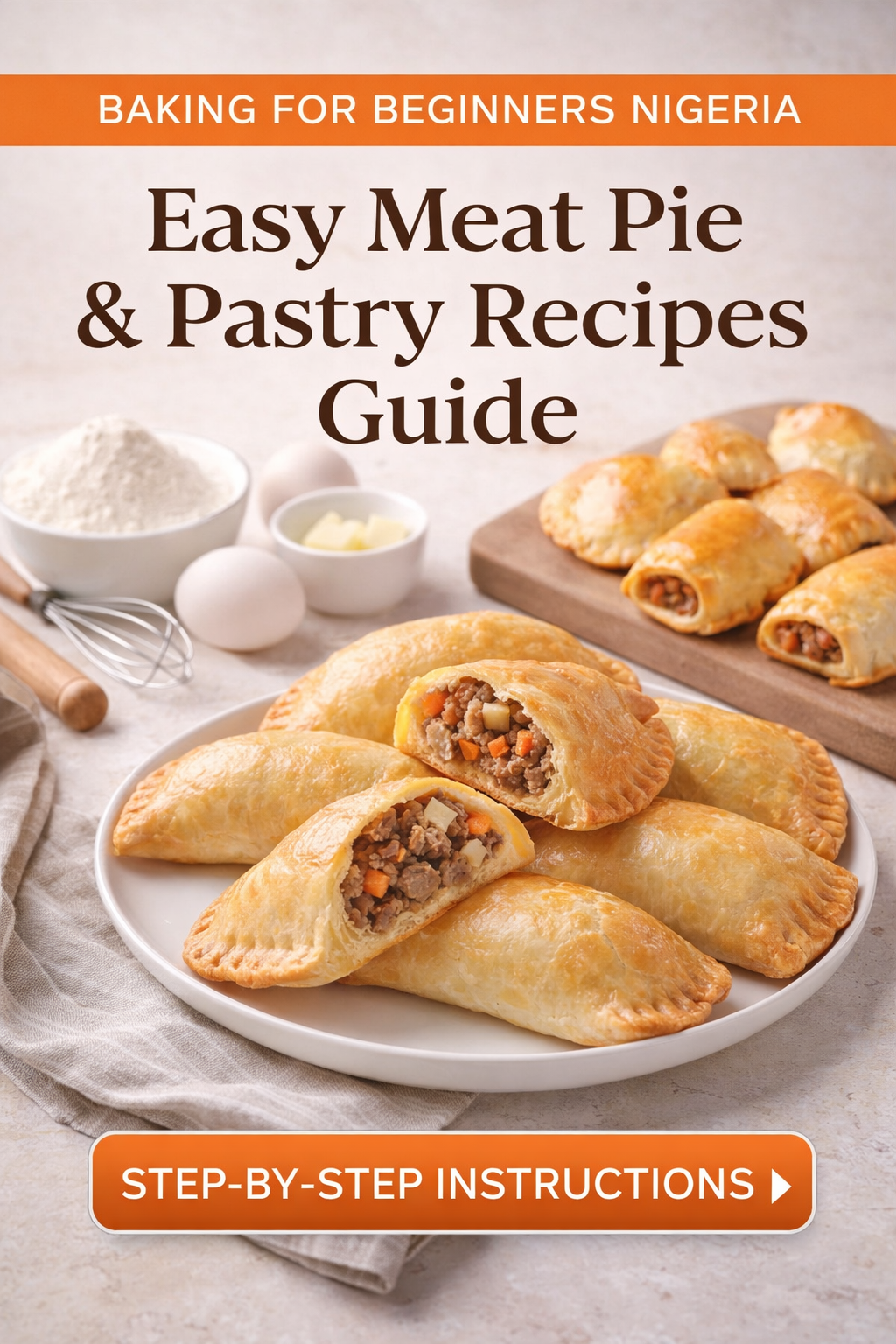
The Meat Pie stands as a quintessential element of Nigerian pastry recipes. It is a handheld pie consisting of a stiff, fat-based pastry shell filled with a savory, spiced minced meat and vegetable mixture. From a culinary perspective, the “Meat Pie” is technically a “hot water crust” or shortcrust pastry, though the Nigerian variant often utilizes a half-fat-to-flour ratio to create a sturdier, less crumbly texture suitable for transportation and street sales.
This recipe is optimized for baking for beginners Nigeria, focusing on techniques that mitigate common local issues, such as the high ambient temperature melting the dough before baking.
Recipe Details
- Prep Time: 30 minutes
- Cook Time: 25 minutes
- Total Time: 55 minutes
- Servings: 6 pies
- Difficulty: Easy
Ingredients Needed
For the Pastry Dough
- All-purpose flour: 250g (approximately 2 cups)
- Margarine (softened): 100g (approximately ½ cup). Margarine is preferred over butter in many Nigerian recipes for its higher melting point and distinct flavor profile.
- Baking powder: 1 tsp (acts as a chemical leavening agent for lightness)
- Salt: ½ tsp (for flavor enhancement)
- Cold water: 3–4 tablespoons (to bind the dough)
For the Filling
- Minced beef: 300g (high protein content)
- Onion: 1 small (diced, provides sweetness and base flavor)
- Irish potatoes: 2 medium (diced into small cubes; starch provides bulk)
- Carrot: 1 medium (diced; adds sweetness and color)
- Flour: 1 tbsp (thickener for the sauce)
- Curry powder: 1 tsp (primary spice blend)
- Thyme: 1 tsp (aromatic herb)
- Stock cube: 1 (provides umami and saltiness)
- Vegetable oil: 2 tbsp (for sautéing)
- Salt: To taste (optional, depending on stock cube salinity)
Egg Wash
- Egg: 1 (beaten; creates a glossy, golden surface via protein coagulation)
Equipment Needed
- Large mixing bowls (for dough and filling)
- Rolling pin
- Baking tray (flat, aluminum or non-stick)
- Pastry brush (for egg wash)
- Cutting board
- Measuring spoons and cups or digital scale
- Frying pan or skillet
Step-by-Step Baking Instructions
- Prepare the Filling: Heat the vegetable oil in a skillet over medium heat. Introduce the diced onions and sauté until they become translucent and lose their pungency. Add the minced beef. The goal is to apply heat until the proteins denature and the meat changes color from red to brown. Breaking the meat into small crumbles increases surface area for even cooking.
- Add Vegetables and Spices: Incorporate the diced potatoes and carrots. These root vegetables require time to soften through gelatinization of their starches. Add the curry powder, thyme, and the stock cube. Pour in a small amount of water (50ml–100ml) to create a steam environment that helps cook the vegetables through. Simmer for 10 minutes.
- Thicken the Filling: Sprinkle the tablespoon of flour over the simmering mixture. Stir continuously to prevent lumps. The flour gelatinizes in the liquid, creating a thick, viscous sauce that holds the meat together. Once thickened, remove from heat and cool completely. Adding hot filling to pastry dough will melt the fat structure, leading to a soggy crust.
- Make the Dough: In a clean bowl, combine the flour, salt, and baking powder. Add the softened margarine. Using the fingertips, rub the fat into the flour until the mixture resembles coarse breadcrumbs. This process coats the flour proteins with fat, limiting gluten development and ensuring a “short” (crumbly) texture.
- Bind the Dough: Add cold water gradually. Too much water activates gluten, making the pie tough; too little results in cracking. Mix until a stiff ball forms. Avoid over-kneading.
- Roll and Fill: Flour a flat surface to prevent sticking. Roll the dough to a thickness of about 3mm. Cut circles using a cutter or a bowl. Place a spoonful of the cooled filling on one half of the circle. Fold the dough over to create a half-moon shape. Seal the edges by pressing with a fork. This crimping action mechanically locks the layers together.
- Bake: Preheat the oven to 180°C (350°F). Arrange the pies on a greased tray. Brush the surfaces with the beaten egg. The proteins in the egg wash will brown rapidly under heat. Bake for 25–30 minutes. The pies are ready when the Maillard reaction has turned the crust a deep golden brown.
Storage Tips
Once baked, the structure of the pie sets. To maintain crispness, store in an airtight container at room temperature for no more than 24 hours. For longer storage, refrigeration is required to retard microbial growth, though this may soften the crust due to moisture migration. Reheating in an oven or toaster oven is necessary to evaporate absorbed moisture and restore texture.
Variations
- Chicken Pie: Substitute minced beef with shredded cooked chicken. Chicken has less fat and connective tissue, requiring less cooking time for the filling.
- Samosa Style: The filling created above is versatile. It can be wrapped in spring roll pastry (dough made from flour, water, and salt) and deep-fried. Deep-frying employs convective heat transfer in oil, creating a crispy exterior rapidly.
Common Mistakes to Avoid in Nigerian Pastry Recipes
Analyzing failures is a crucial part of baking for beginners Nigeria. Most errors stem from a misunderstanding of the role of temperature and handling.
1. Fat Temperature: In hot climates, the margarine used for the dough may soften excessively before baking. If the fat melts into the flour before entering the oven, the pastry loses its ability to form layers. If the kitchen is warm, chill the dough for 15 minutes before rolling.
2. Filling Temperature: As noted, sealing the pie with hot filling causes the steam to generate inside the dough before baking. This results in a “soggy bottom,” where the structural integrity of the base crust fails.
3. Oven Calibration: Opening the oven door frequently drops the temperature. This sudden drop prevents the pastry from puffing up (if using puff pastry) or setting properly. The oven must be a stable thermal environment.
Food Safety and Hygiene for Bakers
In the context of a culinary business or even home cooking, food safety is paramount. In Nigeria, HACCP (Hazard Analysis and Critical Control Points) is the system utilized for identifying and controlling food safety hazards. While HACCP is often voluntary for retail, it is strictly regulated under NAFDAC food hygiene regulations for those exporting or manufacturing.
For bakers using meat, poultry, or fish, strict adherence to temperature controls is non-negotiable. The “Danger Zone” (5°C to 60°C) is where bacteria multiply most rapidly. When preparing the meat pie filling, the meat must be cooked thoroughly to an internal temperature that kills pathogens. Once baked, pies meant for sale should be cooled rapidly and stored at safe temperatures. Documentation of these processes is a standard requirement for professional catering operations.
Furthermore, proper documentation and recall procedures are essential components of NAFDAC compliance. Tastebudzng integrates these regulatory standards into all professional training courses, ensuring that students are not just skilled chefs, but responsible food handlers.
Conclusion
Mastering Nigerian pastry recipes requires a blend of artistic flair and scientific discipline. From the selection of ingredients to the understanding of gluten networks and thermal conductivity, every step matters. By adhering to verified techniques and understanding the “why” behind the process, beginners can achieve professional-grade results. Whether for personal satisfaction or commercial gain, the kitchen is a laboratory of possibilities.
For those seeking to deepen their understanding or launch a career, Tastebudzng offers structured courses that cover these principles in depth. Visit the academy to learn more about baking for beginners Nigeria and elevate your culinary standards.


