

Understanding the True Cost of Production
Many catering operations in Nigeria fail because they price based on intuition rather than data. The most common error is calculating the cost of only the primary ingredients (rice, oil, meat) while ignoring the variables that contribute to the final yield. To determine a profitable menu price, one must account for every input, including the cost of water, cooking gas, seasoning, and even the wear on equipment.
Furthermore, the regulatory landscape adds a layer of necessary expenditure. Food businesses must adhere to strict safety standards. In Nigeria, HACCP (Hazard Analysis and Critical Control Points) is a system for identifying and controlling food safety hazards, regulated under NAFDAC food hygiene regulations. While certification is voluntary unless you are exporting or regulated by federal law, the operational requirements such as maintaining critical control points, temperature controls, and proper documentation are mandatory for safe operation. These compliance costs must be factored into the pricing model to ensure the business remains solvent.
Cost Factors in Pricing Food Services in Nigeria
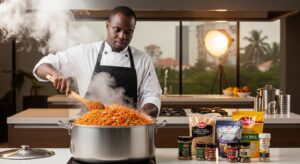
To accurately price a menu item, one must track specific ingredient costs and understand the labor involved. Let us analyze a standard batch of Authentic Nigerian Party Jollof. By breaking down the recipe, caterers can see exactly where the capital goes and how the “party” flavor typically derived from large-pot cooking over firewood impacts the cost structure. This analysis assumes a batch size intended to serve 10 people, providing a clear unit cost baseline.
Recipe Details: Authentic Nigerian Party Jollof
- Prep Time: 30 minutes
- Cook Time: 60 minutes
- Total Time: 1 hour 30 minutes
- Servings: 10 People
- Difficulty: Medium
Equipment Needed
- Large heavy-bottomed pot or cast iron pot (essential for heat retention and the smoky base)
- High-powered blender
- Measuring cups and spoons
- Spatula or wooden spoon
- Ladle
Ingredients & Cost Estimates
The authenticity of Nigerian Jollof relies on specific chemical interactions between the tomatoes, oil, and rice. Deviations from these ingredients not only alter the flavor profile but can also affect the cooking yield.
- Parboiled Rice: 4 cups (approx. 800g). Recommended brands include Caprice or Mama Gold. Note: Parboiled rice is already processed during manufacturing, so do not parboil again.
- Plum Tomatoes: 1kg (blended). These provide the acidic base required for the stew.
- Tatashe (Bell Peppers): 2 large pieces (blended). Adds sweetness and body to the sauce.
- Rodo (Scotch Bonnet Peppers): 1 to 2 (depending on heat preference). Essential for the characteristic heat.
- Onions: 3 medium bulbs (1 blended into the mix, 2 sliced for the base).
- Vegetable Oil: 1 cup. Use vegetable oil as the primary fat; coconut oil is not traditional for Nigerian jollof.
- Stock: 3–4 cups (from beef, chicken, or turkey). This is a critical flavor carrier.
- Protein (Optional): Smoked turkey or fish. These can be added for depth, though the rice stands well on its own.
- Seasoning: 2 stock cubes, 1 tsp thyme, 1 tsp curry powder, 2 bay leaves.
- Salt: To taste.
Instructions & Yield Analysis
The following procedure outlines the preparation of the dish. Understanding the time and heat involved allows caterers to calculate labor and energy costs.
- Prep the Stew (Base): Blend the plum tomatoes, tatashe, rodo, and one onion bulb. Heat the vegetable oil in your heavy-bottomed pot until hot. Bleaching the oil slightly is acceptable to reduce its raw taste, but do not burn it. Add the blended mix and fry. This step requires patience; fry until the water dries and the oil rises to the top (caramelization), indicating the concentration of flavors.
- Seasoning Integration: Add the curry powder, thyme, stock cubes, and bay leaves to the caramelized stew. Stir continuously for 2 minutes. This heat allows the fat-soluble flavors in the spices to bloom and infuse into the oil.
- The Rice: Wash the parboiled rice once in cold water. Scientific Note: Do not parboil again. The rice has already undergone hydrothermal processing; additional parboiling will result in a mushy texture and nutrient loss. Add the washed rice to the stew and stir thoroughly to coat every grain.
- Cooking: Add the hot stock immediately. The liquid level should be slightly above the rice. Cover the pot tightly to trap steam. Cook on high heat for the first 10 minutes to bring the temperature up quickly, then reduce to medium heat.
- Developing the Smoky Flavor: The signature “party Jollof” taste comes from the evaporation of water and the subsequent slight burning of the stew at the pot’s bottom (the “bayo”). Allow the rice to steam until the liquid is absorbed. Do not add liquid smoke; the authentic flavor is achieved through direct heat contact or firewood cooking.
- Resting: Turn off the heat and let it steam for 5 minutes. This residual heat completes the starch gelatinization process without overcooking the grains.
Hidden Costs: HACCP and Safety
When determining the final price for your services, the “invisible” costs of safety must be included. In the Nigerian context, HACCP implementation is not just paperwork; it is a physical operational cost.
Identifying critical control points (CCPs) such as the temperature of the stock when added to the rice or the duration of the cooking phase is vital. Maintaining these controls requires thermometers, recording sheets, and staff training time. Additionally, hygiene protocols dictate the need for specific cleaning agents and separate storage containers to prevent cross-contamination. If a business ignores these factors to save money, they risk NAFDAC enforcement actions or, worse, foodborne illness outbreaks that can destroy brand reputation. Therefore, a portion of the profit margin must be allocated to maintaining these safety standards.
Strategies for Pricing Food Services in Nigeria
Once the cost of production—including ingredients, labor, energy, and compliance—is calculated, the next step is applying a pricing strategy. There are two primary methods used in the industry.
1. The Cost-Plus Pricing Method
This is the most scientific approach. You calculate the total cost to produce the dish (e.g., the total cost of the Jollof recipe divided by 10 servings) and add a markup percentage.
Formula: Total Cost ÷ Target Food Cost % = Menu Price.
For example, if the total cost of a pot of Jollof is ₦5,000 and it yields 10 servings, the cost per plate is ₦500. If your target food cost is 30%, the selling price should be ₦500 ÷ 0.30 = ₦1,666. This ensures that 70% of the revenue covers overhead and profit.
2. Value-Based Pricing
This method allows for higher margins by charging based on the perceived value of the brand. If you specialize in “Authentic Wood-Cooked Party Jollof,” the market may perceive this as superior to standard rice. If you use high-end ingredients like smoked turkey or have professional certification from Tastebudz Academy, you can charge a premium. However, this requires a deep understanding of your target demographic’s willingness to pay.
Conclusion
Mastering how to price food for profit is a skill that separates hobbyists from professionals. It requires a shift from cooking intuitively to cooking analytically. By rigorously tracking ingredient costs using authentic recipes like the Party Jollof outlined above—and factoring in the necessary expenses of NAFDAC compliance and HACCP safety protocols, caterers can build sustainable businesses. Remember, profitability ensures that you can continue to provide the high-quality, authentic culinary experiences that your clients desire.
For those looking to deepen their understanding of culinary business management or authentic Nigerian cooking techniques, Tastebudz Academy offers comprehensive training designed to empower the next generation of culinary professionals.